Every car owner has stood in their driveway at some point wondering: "Can I do this myself, or do I really need to pay someone?" It's a fair question — detailing prices at the professional level aren't trivial, and there's a certain satisfaction in cleaning your own car well. But there's also a certain heartbreak in watching a DIY job that damaged the paint or left a permanent mark, and that ends up costing more to fix than a professional job would have cost in the first place.
We see both sides in our Karen workshop every week — cars that have been beautifully maintained at home, and cars where well-intentioned DIY work has caused real damage. This article is the honest breakdown we'd give a friend: what you can genuinely do yourself, what you absolutely can't, and the in-between jobs where the call depends on you.
The three categories of car care
Rather than thinking "DIY or pro", it helps to break car care into three groups based on what's actually at stake:
Almost all car owners overthink the first category (assuming it needs a pro when it doesn't) and underthink the second (assuming it's easy when it isn't). The categories below should clarify both.
Category 1: Safe for DIY
With the right tools and technique, these tasks are perfectly doable at home — and genuinely just as effective as a professional job when done properly:
✓ Regular hand washes (weekly to fortnightly)
A properly executed two-bucket wash at home is indistinguishable from a professional one. The key is method: two buckets (one soapy, one rinse), a quality microfibre wash mitt, pH-neutral car shampoo, and drying with a clean plush microfibre towel. Never use dish soap, a sponge, or an old rag — these are the three biggest causes of DIY-induced paint damage.
Time per wash: 45–60 minutes. Cost per wash (materials): KES 150–300. Professional equivalent: KES 500–1,000. For most owners, DIY washing is the single biggest ongoing savings.
✓ Interior vacuuming and dusting
A quality home vacuum with attachments can handle 90% of interior cleaning. Focus on: seats, footwells, boot, seat rails, dashboard dusting, and vent dusting with a soft brush. This is not the same as a full deep detail (see Category 2), but it's the routine work that keeps an interior fresh between deeper cleans.
Time per session: 20–30 minutes. Cost per session: minimal (own vacuum). Professional equivalent: KES 1,500–3,000.
✓ Glass cleaning (interior and exterior)
Using a quality glass cleaner (never household glass cleaner with ammonia) and two clean microfibre cloths — one for applying, one for buffing — you can achieve professional-grade glass clarity at home. This is the one detail task that's essentially free to learn and gets you 90% of the way to a pro result.
Time: 15 minutes. Cost: minimal. Professional equivalent: often bundled.
✓ Tire dressing
Clean tyres thoroughly, let them dry, and apply a quality water-based tire dressing with a foam applicator. Water-based products are less greasy than silicone-based ones and don't sling off onto paint. This is the single highest-impact visual upgrade you can do yourself in under 10 minutes.
Time: 10 minutes. Cost: KES 1,500 per bottle (lasts months). Professional equivalent: often bundled.
✓ Spray sealant / ceramic booster application
Modern spray-on sealants and ceramic boosters are extremely user-friendly. Spray onto a panel, wipe with one microfibre, buff with another. Takes 20 minutes for the whole car and delivers 3–6 months of protection. This is a legitimate DIY alternative to waxing every month.
Time: 20 minutes. Cost: KES 2,000 per bottle (multiple applications). Professional equivalent: not necessary — this is genuinely a DIY task.
Category 2: DIY with high risk
These tasks are technically doable at home, but the margin between a great result and damage is narrow. Attempt only if you have the right tools, the patience to learn, and the willingness to accept the risk:
⚠ Deep interior detail (steam, extraction, leather conditioning)
You can do parts of this at home — leather cleaning, spot treatment, some stain removal. But without a steam cleaner and hot-water extractor, you're only doing 40% of the work. Chemical cleaners are also easy to misuse; using the wrong product on leather, fabric or plastic causes permanent damage. We regularly see DIY-damaged interiors where cleaners were used incorrectly.
If doing it yourself: keep to gentle, pH-balanced products and stick to the surfaces you're confident about. Leave extraction, steam, and leather conditioning to a professional if the interior is more than lightly soiled.
⚠ Scratch removal by hand polish
Hand polishing a small area with a mild abrasive polish can safely remove very light scratches. But you cannot remove real swirl marks or deep scratches by hand — it's physically impossible to generate the heat and pressure required. Attempting it often just temporarily hides the defect (with wax or filler) or causes marring from uneven pressure.
If doing it yourself: limit to mild products, test on a small area first, and accept that truly correcting paint requires machine polishing.
⚠ Headlight restoration kits
Store-bought kits can improve headlight clarity, and if you follow the instructions patiently, you'll often get a decent result. But most kits skip the UV sealing stage, meaning the yellowing returns within 2–3 months. You'll also notice uneven results if the sanding is rushed — visible as cloudy patches on the lens.
If doing it yourself: buy a kit that includes UV sealant, take your time with the wet sanding stages, and expect to redo it within a year. Our professional version lasts 2–3 years.
⚠ Wheel deep cleaning (aggressive cleaners)
Light wheel cleaning with pH-neutral wheel cleaner is completely safe. But acidic or strongly alkaline wheel cleaners — often sold as "heavy-duty" — can damage your wheel's finish and even corrode brake components if they run into the wheel well. Non-professionals often over-apply these products, leave them too long, or don't rinse thoroughly.
If doing it yourself: use pH-neutral products only, work on cool wheels (never hot), and rinse thoroughly.
⚠ Engine bay cleaning
This is one of the highest-risk DIY tasks on the list. High-pressure water near electrical components can cause serious electrical damage — ECU, alternator, fuse box, sensors. We see the aftermath regularly. If you must do it yourself: engine off, engine COOL, no high-pressure water, mask electrics, work with rags and degreaser rather than spray, and dry thoroughly before starting the car. But honestly, this is a task worth paying for.
Category 3: Professional only
These tasks genuinely require professional equipment, environment or training. Attempting them at home is not just risky — it's likely to fail:
✗ Machine paint correction
Professional machine polishing removes swirl marks, scratches and oxidation safely — but only in trained hands. Modern dual-action polishers can still cause damage if used incorrectly, and rotary polishers can burn through clear coat in seconds. Without a paint depth gauge and experience reading polish behaviour, DIY correction is a very expensive gamble.
✗ Ceramic coating application
Consumer-grade ceramic products exist, but a genuinely durable 3–5 year coating requires preparation (correction), a dust-controlled environment, controlled temperature, and the ability to spot "high spots" (uneven coating that becomes visible as it cures) under proper lighting. Applied wrong, a ceramic coating can be harder to remove than wax and can leave permanent marks.
✗ PPF installation
Paint protection film installation is one of the most skill-dependent services in the detailing world. Complex curves, tight edges and covered panels require experience, specialised tools, and a controlled environment. DIY PPF attempts typically result in visible bubbles, lifting edges, wrinkles and stretched film — plus the wasted cost of the film itself.
✗ Vinyl wrap installation
Same as PPF — a professional skill, requiring disassembly of trims and handles, heat control, and experience with adhesive behaviour. DIY wrap attempts usually fail within months as edges lift and bubbles form.
✗ Window tinting
Pre-cut DIY tint kits exist, but the results are almost always visibly amateur — bubbles, trapped dust, wavy edges and lifting corners. Modern ceramic film requires heat shrinking to glass contours, which is a professional technique. Poorly applied tint is also harder to remove than to install correctly in the first place.
✗ Any paint or bodywork
Panel repairs, spray painting, accident repair, dent removal — these require a spray booth, professional paint systems, and years of training. Rattle-can DIY jobs rarely match properly and often end up costing more to fix than the original job would have cost.
A practical DIY toolkit for Nairobi owners
If you want to do the Category 1 tasks well, here's the starter kit we recommend:
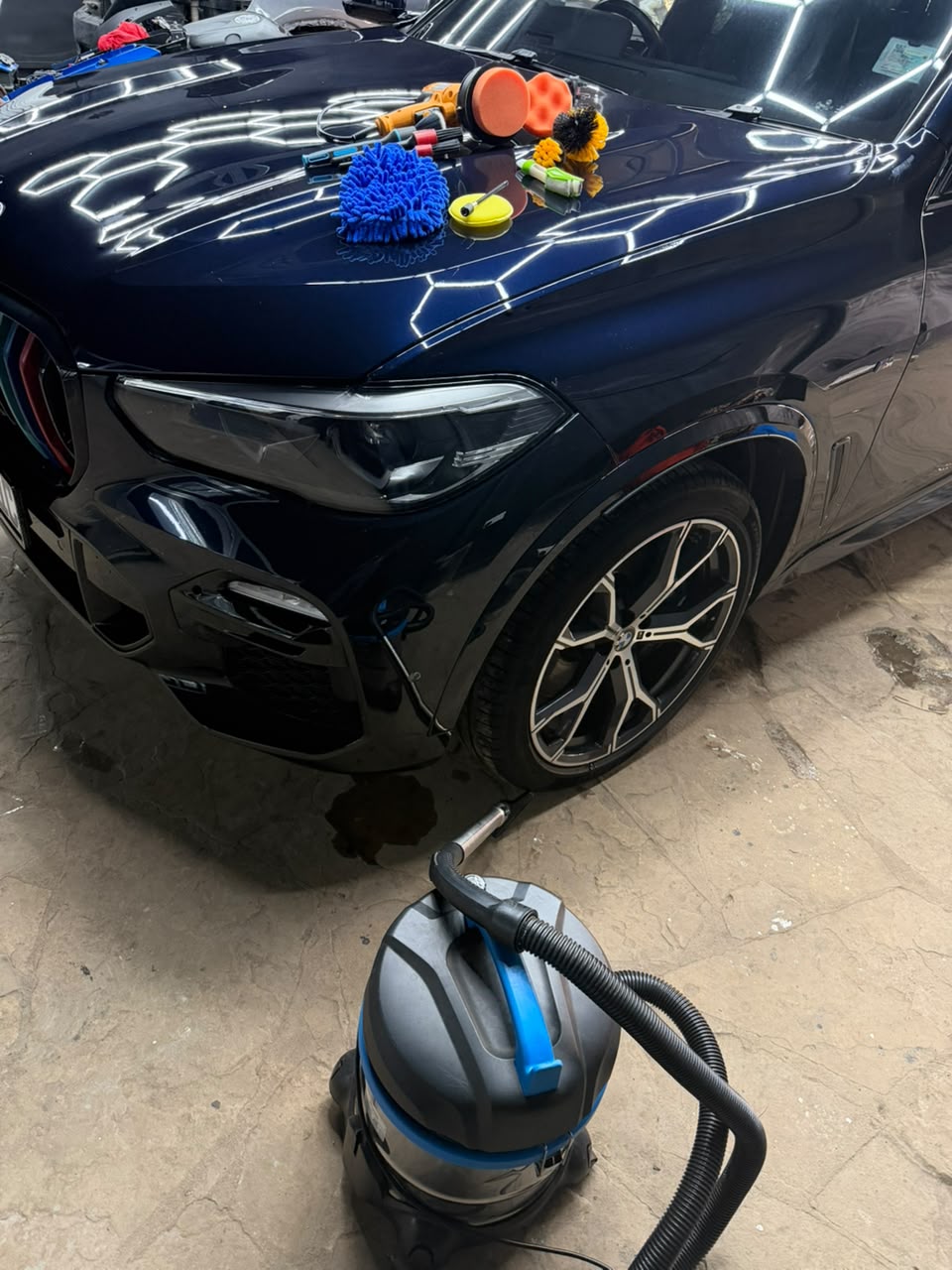
- Two 20L buckets — with grit guards if possible. Foundation of the two-bucket wash.
- Quality microfibre wash mitt — not a sponge, not a brush. Deep-pile chenille is best.
- pH-neutral car shampoo — never dish soap. Look for products that are safe for ceramic coatings if applicable.
- 3–4 large plush microfibre drying towels — 600gsm minimum. These absorb water fast and safely.
- Ammonia-free glass cleaner — plus two clean microfibres for glass only.
- Water-based tire dressing — plus a foam applicator. Water-based is safer than silicone-based.
- Spray sealant / ceramic booster — for keeping protection topped up between professional details.
- Soft detailing brushes — for vents, badges, grilles and wheel spokes.
Total cost: KES 8,000–15,000. This kit will last a year or more and pay for itself many times over in avoided professional washes. Just remember: buy car-specific products, not household cleaners.
How to think about the trade-off
When deciding DIY vs professional, ask yourself these three questions:
The 80/20 approach — what most owners actually do
For most of our customers at DOP, the optimal arrangement is:
- DIY weekly or fortnightly: Washes, interior vacuum, glass cleaning, tire dressing, spray sealant top-ups.
- Professional every 3–6 months: Full interior deep detail, paint correction, headlight restoration, engine bay, wheel restoration.
- Professional as needed: Ceramic coating, PPF, wraps, tinting, paintwork, accident repair.
This split keeps your car genuinely well-maintained, saves you serious money over the year, and leaves the high-risk high-skill work to people who do it every day.
Frequently asked questions
The bottom line
DIY detailing is genuinely worth doing for the routine tasks — washes, interior vacuums, glass, tire dressing, spray sealant top-ups. Get these right and you'll save real money over the year while keeping the car looking sharp. But the deep, high-skill work — machine correction, coatings, PPF, wraps, tinting, paintwork — is worth paying for. Attempting those yourself is a false economy: the tools, skill and environment required mean the odds of causing damage are far higher than the odds of a great result.
If you're unsure where a specific task falls, call us on 0775-358-836 or send us a message. We'll tell you honestly whether it's worth doing yourself — even if that means recommending less work for us.
Due for a Professional Detail?
Book a full interior + exterior detail at our Karen studio, or use our Instant Quote tool for pricing on your specific car. Free pickup and delivery within Karen.